この曲についてAbout the piece
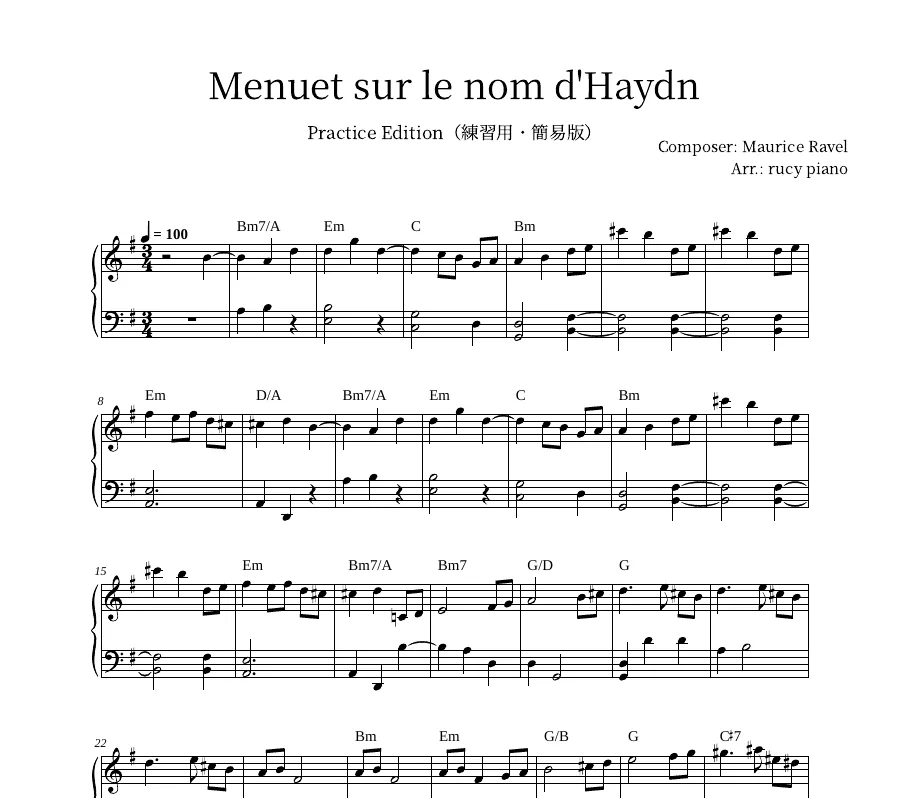
1909年はハイドン(1732〜1809)が亡くなって100年の年でした。パリの音楽雑誌『S.I.M.』がこれを記念して、6人のフランスの作曲家(ドビュッシー、デュカス、アーン、ダンディ、ヴィドール、ラヴェル)に「HAYDNの5文字を音にした主題」でピアノ曲を書いてもらい、1910年1月号に載せました。ラヴェルのこの曲は全54小節、1分半ほどのト長調のメヌエットです。
1909 marked the hundredth anniversary of Haydn's death. The Paris journal Revue musicale S.I.M. asked six French composers — Debussy, Dukas, Hahn, d'Indy, Widor and Ravel — each to write a piano piece on a theme spelled from the letters of HAYDN, and printed them in its January 1910 issue. Ravel's contribution is a 54-bar minuet in G major, about a minute and a half long.
名前を音にするしくみ:H はドイツ式の音名でシ。A はそのままラ。残りの文字は、アルファベットをラ〜ソの7音に順にくり返し当てはめて決めます。すると Y はレ、D はレ、N はソ。つまり「HAYDN = シ・ラ・レ・レ・ソ」です。
How a name becomes notes: H is the German name for B, and A is simply A. The other letters are found by laying the alphabet over the seven notes A–G again and again, so Y becomes D, D stays D and N becomes G. HAYDN = B–A–D–D–G.
いたずらっぽい仕掛け:ラヴェルは楽譜に「H A Y D N」の文字を自分で書き込んでいます。最初は右手の旋律に、途中では左手に、さらに「N D Y A H」と後ろから読んだ形や、上下をさかさまにした形(文字までさかさまに印刷されています)でも出てきます。何回見つけられるか、楽譜で探してみてください。
The playful part: Ravel wrote the letters H A Y D N into the score himself. The name appears first in the right-hand melody, then in the left hand, then backwards (N D Y A H) and even upside down — the letters are printed upside down too. See how many you can find.
簡易版では、原曲のいちばん上に聞こえる旋律をそのまま右手に残し、左手は各拍の低い音だけにしぼってコードネームを付けています。
The Practice Edition keeps the uppermost melody exactly as written in the right hand and reduces the left hand to the bass notes, with chord names.
練習のコツPractice tips
- メヌエットは宮廷の踊り。1拍目を少し大切に、2・3拍目は軽く、上品に。
- A minuet is a court dance: give beat 1 a little weight and keep beats 2 and 3 light and graceful.
- 最初の「シ・ラ・レ・レ・ソ」がこの曲の顔です。出てくるたびに、少しだけはっきり歌いましょう。
- The opening B–A–D–D–G is the face of the piece. Sing it out a little each time it returns.
- 小さな装飾音(前打音)は、拍の直前にさっと軽く入れます。
- Play the small grace notes quickly and lightly, just before the beat.
- 最後は「Retenu(少し遅く)」「Lent(ゆっくり)」。左手の「H A Y D N」を聴きながら、静かに終わります。
- The ending slows down (Retenu, then Lent). Listen for the left-hand H A Y D N as the piece fades away.