この曲についてAbout the piece
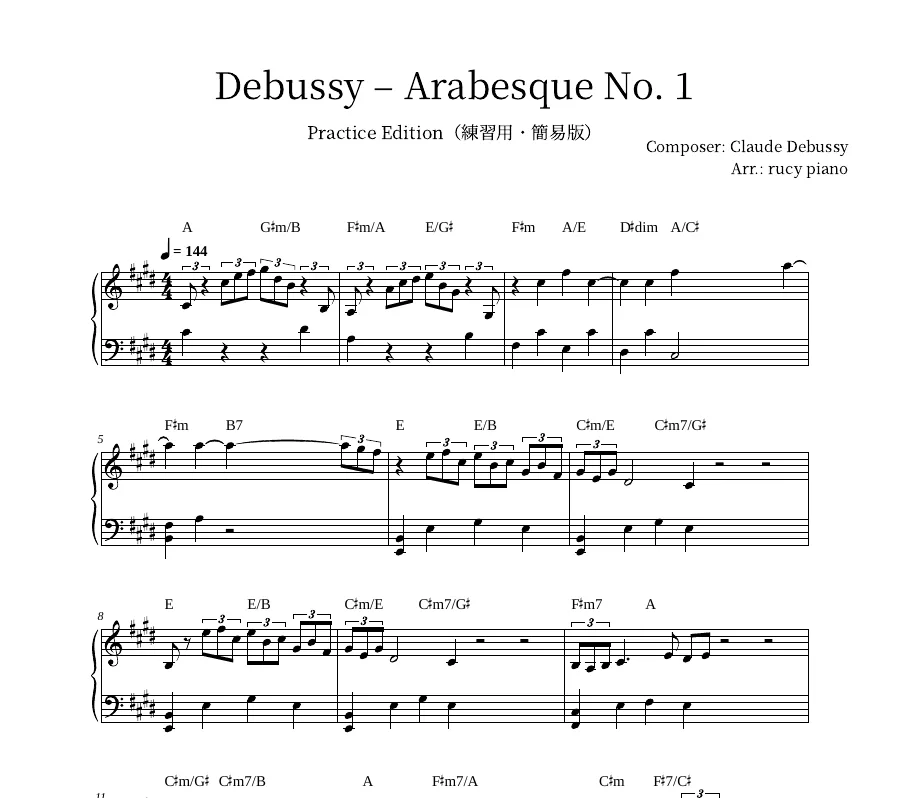
ドビュッシーが20代のころに書いた「2つのアラベスク」の1曲目で、1891年に出版されました。アラベスクとは、つる草のような曲線が続くイスラム美術の模様のこと。その名のとおり、3連符のアルペジオが曲線を描くように流れていきます。
The first of Debussy's Deux Arabesques, written in his twenties and published in 1891. An arabesque is a flowing, vine-like ornament, and the triplet arpeggios curl through the piece in the same way.
原曲の大きな難しさは、右手の8分音符2つと左手の3連符が同時に進む「2対3」のリズムです。中間部はテンポを少し落とし、ゆったりした歌に変わります。そのあと最初のアルペジオが戻ってきて、静かに終わります。
The main challenge of the original is the "two against three": duplet eighths in one hand against triplets in the other. The middle section slows into a song before the opening arpeggios return and the piece fades away.
簡易版は原曲のいちばん上の旋律をそのまま残し、ベースとコードネームを付けています。2対3の重なりを減らしているので、まず旋律の形を覚えるのに向いています。
The Practice Edition keeps the top melody exactly as written, with a bass line and chord names. Much of the two-against-three overlap is removed, so it is a good way to learn the shape of the melody first.
練習のコツPractice tips
- テンポは♩=144と速めです。最初はプレーヤーで50〜60%に落とし、3連符を「タ・タ・タ」と均等に弾く練習から始めましょう。
- The tempo is a brisk ♩ = 144. Start at 50–60% in the player and make the triplets perfectly even.
- アルペジオは手首を小さく横に動かすと、指だけで弾くより楽に、なめらかになります。
- Let the wrist travel sideways with the arpeggios; it is smoother and easier than using fingers alone.
- ホ長調(♯4つ)です。F♯・C♯・G♯・D♯の黒鍵を先に確認しておきます。
- It is in E major: check F♯, C♯, G♯ and D♯ before you begin.
- 中間部は「歌うように」。テンポを少しゆるめても大丈夫です。
- Sing the middle section; it is fine to relax the tempo there.