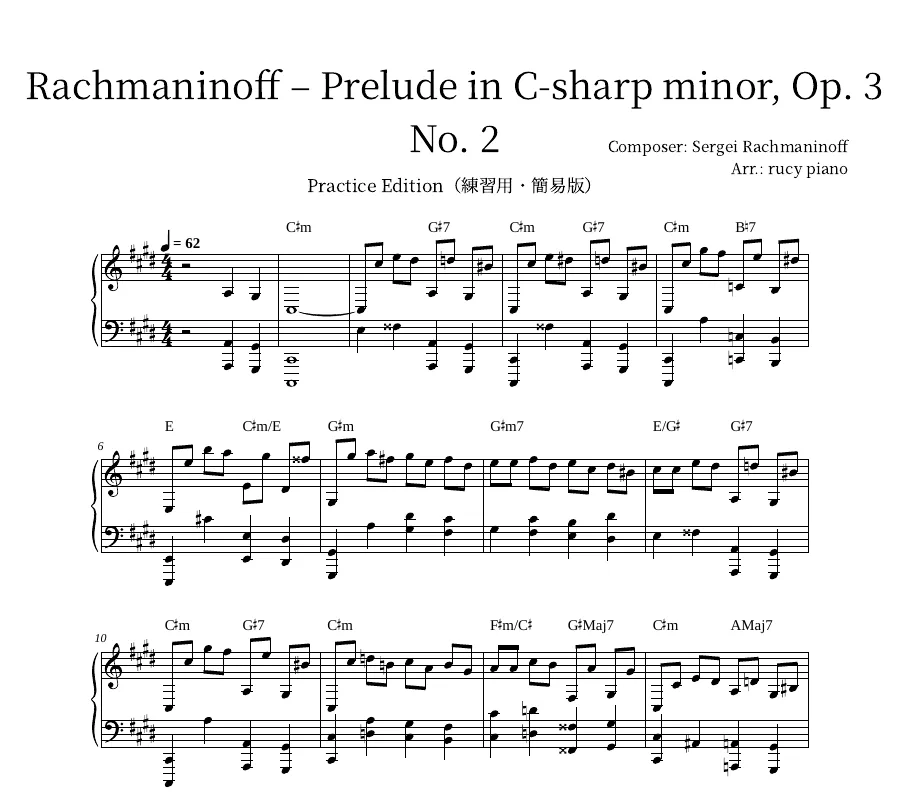
この曲についてAbout the piece
セルゲイ・ラフマニノフが1892年、19歳のときに書いた前奏曲で、ピアノ曲集「幻想的小品集 作品3」の2曲目です。同じ年にモスクワで本人が初演しました。「鐘」や「モスクワの鐘」という呼び名がありますが、これはラフマニノフ自身が付けたものではありません。
Sergei Rachmaninoff wrote this prelude in 1892, aged 19, as the second of his Morceaux de fantaisie, Op. 3, and premiered it himself in Moscow that year. The nickname "The Bells (of Moscow)" did not come from the composer.
曲はとても大きな音の3つの音(ラ・ソ♯・ド♯)で始まり、鐘が鳴り響くような重い和音が続きます。中間部は「アジタート(激しく)」で、3連符が嵐のように動きます。最後は冒頭の和音が4段の楽譜に広がって大きく戻り、静かに消えていきます。
It opens with three thunderous notes, A, G♯ and C♯, followed by heavy, bell-like chords. The middle section, Agitato, storms along in triplets. The opening returns spread over four staves before the piece dies away.
この曲は発表直後から大人気になり、ラフマニノフは演奏会のたびにアンコールで求められたといわれます。簡易版は原曲のいちばん上の旋律をそのまま残し、ベースとコードネームを付けています。
The prelude became hugely popular almost at once, and audiences demanded it at Rachmaninoff's recitals. The Practice Edition keeps the top melody exactly as written, with a bass line and chord names.
練習のコツPractice tips
- 冒頭の3つの音は、腕の重さを鍵盤に落とすように。指で押すより、深くて響く音になります。
- Drop the weight of your arm into the opening three notes rather than pushing with your fingers.
- 嬰ハ短調(♯4つ)です。F♯・C♯・G♯・D♯に加え、B♯(シの♯=ド)も出てくるので注意しましょう。
- C♯ minor has four sharps (F♯, C♯, G♯, D♯), and B♯ appears often too.
- 中間部の3連符はまず50%くらいでリズムをそろえ、慣れてから速くしていきます。
- Even out the Agitato triplets at about 50% before speeding up.
- ペダルは和音が変わるたびに踏みかえます。鐘の余韻を残しつつ、濁らないように耳で確かめましょう。
- Change the pedal with each chord, keeping the bell-like ring without blurring.